New spins…
MARILLION
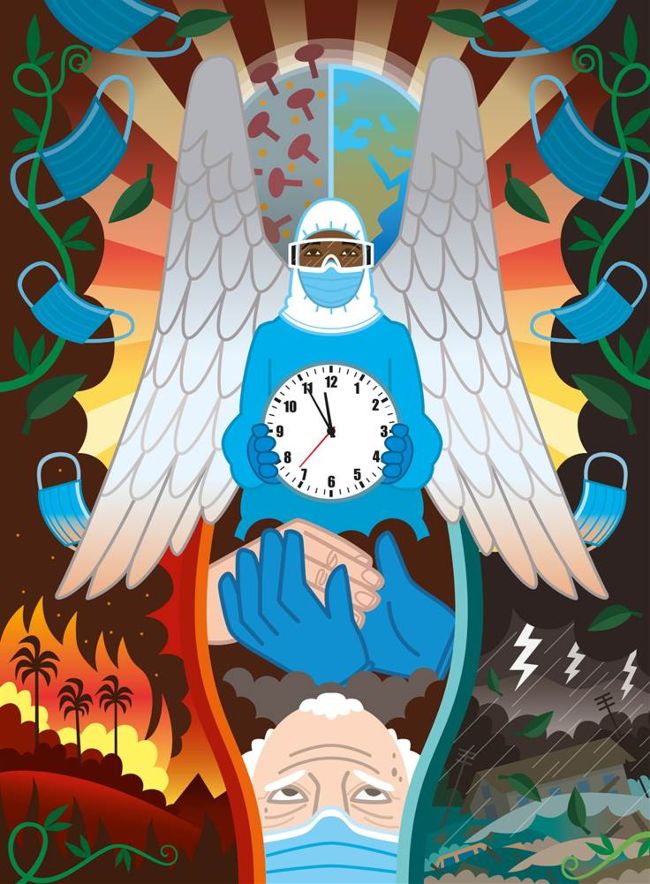
The clock is running down on us all, and Steve Hogarth and co are counting the seconds on their lushly pre-apocalyptic new album.
Words: Johnny Sharp llustration: Pete Fowler
Before the release of Marillion’s last album, FEAR. (Fuck Everyone And Run), Steve Hogarth expressed despair at self-serving attitudes on the rise, even before Brexit and Trump loomed into view: “I have a feeling that we’re approaching some kind of sea change in the world – an irreversible political, financial, humanitarian and environmental storm. I hope that I’m wrong.”
Obviously no one really foresaw the events of the past two years, but the response to it among individuals as well as governments has arguably confirmed Marillion’s world view. Nearly six years later, it’s fair to say things aren’t looking any rosier. And Hogarth’s unease has evolved into something faintly pre-apocalyptic, if FEAR’s follow-up is anything to go by.
An Hour Before It’s Dark takes its title and central theme from the feeling that there’s a clock ticking ever louder as people squabble over the fundamental right not to get a needle pricked in their arms or reduce their carbon footprint. And from the very start of the album, Marillion sound determined to grab the listener by the lapels.
Be Hard On Yourself is based around an intriguing central lyrical idea, which seems to contradict the prevailing wisdom that we need to #bekind to ourselves in these trying times. Hogarth might agree up to a point, but ultimately he’s appealing to us to make sacrifices for the sake of our fellow humans because ‘You’ve been spoiled for year’ and, as he warns towards the climax, ‘We haven’t got long… til the end of this song.’
Messrs Rothery, Kelly, Trewavas and Mosley drive home the point, with an earworm of an anthemic chorus, before the tempo picks up in the final minutes and the urgency spirals as if to confirm his words, a mad dash before the listener bursts suddenly out into the open air and the band falls away, as Hogarth breathessly gasps, ‘We’ve got an hour before it’s dark.’
An Hour Before It’s Dark
EARMUSIC
But the sentiments aren’t just about altruism – Hogarth is admitting that self-interest and fear of our own futures are tied up in it too, as Reprogram The Gene confirms. ‘I don’t want to be food for the trees,’ he roars defiantly, referring to ‘Greta T’ alongside a situation, which ‘begins with the letter C’ where ‘the cure’s coming at us, the cure is the disease’. Is he saying the pandemic might just prove a wake-up call to address other, more long-term global issues? That’s in the ear of the beholder.
A further irony that will probably stick more firmly in most fans’ heads comes in the epic chorus of Murder Machines, where Hogarth sings ‘I put my arms around her, and I killed her with love’, which seems as good a summary as any of the heartbreaking feeling of passing on a deadly virus that many might have felt over the past two years.
If that’s the emotional peak of the record, the album’s second half initially seems like a bit of a comedown in comparison, as The Crown And The Nightingale and Sierra Leone don’t grab the attention quite so readily. The arena rock swell begins to plateau and drift, while the lyrics are more wreathed in symbolism, as in the latter song’s tale of finding a diamond in a rubbish heap and resolving not to sell it.
There’s a more incisive edge to the 15-minute closing track, as Care sets fears of our own mortality against the overarching theme of a planet facing a race to avert disaster. ‘Who knows how much time they’ve got left?’ Hogarth asks, and his point is reinforced more dynamically as swampy funk-infused basslines add to the sense of mild panic. That in turn only enhances the impact when a fullfat Rothery guitar line, borne on the wings of a mighty orchestral rock storm, swoops out of nowhere, before it plunges back into murky self-doubt. These are breathtaking moments, benefitting from sonic contrasts that weren’t quite so arresting in the preceding tracks.
Hogarth references previous lyrics on the album, including the title, as if elements of our journey are flashing before us as we prepare for the final curtain. But this time, either side of recalling once more how ‘she wrapped her arms around me’ a celestial choir envelopes us and our hero seems to be revitalised with an important earthly realisation: ‘The angels of this world are not in the walls of churches… The heroes in this world, working while we’re all sleeping.’ The ones who’ve been a little harder on themselves, perhaps?
And finally, a relatively happy ending is delivered. ‘An angel here on Earth came down here to carry me home,’ sings Hogarth at the track’s close. It’s a soothing, redemptive ending to an album full of anxiety and uncertainty. But within it all is a stirring and timely message. And there’s plenty of powerful sounds herein to keep us listening to it, for however much time we’ve got left.
ROSALIE CUNNINGHAM
Two Piece Puzzle CHERRY RED
A masterclass in form and style from prog’s psych queen.
To borrow a phrase from ancient Rome, via the Royal Air Force motto, the second solo album from former Purson frontwoman Rosalie Cunningham proves the truth behind the expression ‘per ardua ad astra’: through hardships to the stars. Unable to work with her band during the pandemic, during which the artist contracted Covid, Cunningham created her new record working in isolation with her partner Rosco Levee, hence the Two Piece Puzzle of the title. Yet despite the restrictions imposed by the lockdown, Cunningham sounds inspired throughout.
The psychedelic flavours of Purson and Cunningham’s 2019 solo debut still permeate the new music, but in terms of the compositions and sounds found on the album, The Beatles and Queen seem to be key points of reference. Listening to the piano parts in Duet and The Liner Notes, it’s easy to think of Billy Preston with The Beatles, while Trististia Amnesia channels Ringo’s fat, thuddy drum sound from Come Together and the droning intro has the eastern vibe of the sitar-powered Within You Without You.
Cunningham has always displayed an enviable ear for a melody, but she has surpassed herself here. She packs ideas into every tune and seems fully fluent and at ease operating in a range of styles, switching tempos and feels within a single composition without ever throwing the listener off the trail. Donovan Ellington and Donny Part Two tell the story of a blacksmith running away to seek his fame and fortune and would be comfortably at home on Queen’s Night At The Opera with their mix of rock, folk, and musical theatre. Fairport Convention’s Ric Sanders brings out the sea shanty qualities of Donny Part Two with his jaunty fiddle playing.
Duet is a mid-album highlight with Levee and Cunningham sharing the vocal duties in a song carried along on a cheerful bouncing piano that morphs into a trippy, psychedelic guitar workout. Suck Push Bang Blow delivers a hefty glam rock stomp and boasts a gloriously fuzzed-out garage rock guitar solo, before the album wraps up with the brilliant The Liner Notes. This one draws on a laid-back lounge feel, a reminder that alongside psychedelia, the 60s were swinging, but then the song shifts gears into a rock beat before a fabulously catchy mid-section that Paul McCartney would be proud to call his own.
Two Piece Puzzle is an album that will amply reward the listener’s fullest attention in appreciating both the skilfulness of the compositions and Cunningham’s witty, occasionally surreal lyrics. This promises to be one of the early musical landmarks of 2022.
DAVID WEST
AMORPHIS
Halo ATOMIC FIRE
Finland’s prog metal pioneers continue to be brilliant.
Amorphis have been so laudably consistent over the past three decades that it will come as no surprise that their 14th studio album is yet another corker. Halo sticks to the Finns’ established formula, but they have rarely sounded as inspired by its creative possibilities as they do here.
Northward
may be their finest album opener yet, thanks to a stirring chorus hook, sung and growled with gusto by frontman Tomi Joutsen. On The Dark Waters is equally dazzling, as the band’s gritty riffing is born aloft on thick waves of spiralling synths. Elsewhere, The Moon is as epic and mysterious as its title suggests, with echoes of 80s gothic rock, a wonderfully woozy instrumental section and another towering chorus; while both Seven Roads Come Together and War combine ingenious arrangements and dark, metallic bluster with yet more life-affirming melodies.
As with every Amorphis album this century, Halo has no discernible weak points, and every last song delivers at least one jolting dose of folk-tinged melodic euphoria. And just to cap off another triumph, the closing My Name Is Night may be the most beautiful song the band have ever written.
DL
BABER & WILEMAN
Baber & Wileman BELIEVERS ROAST
Powerful debut album from kindred-spirit prog mavericks.
Sometimes the best things happen by accident. Having previously collaborated in 2011, Matt Baber from Sanguine Hum and Karda Estra’s Richard Wileman reconvened in 2020 with a view to perhaps completing a couple of tracks but this quickly grew to a full album.
There are echoes of their respective outfits but this beguiling collection of four songs and five instrumentals slip beyond any strict categorisation. The writing is crisp and flawlessly arranged. Steeped in acoustic reveries, tessellating electronica, or dramatic, magisterial themes, the cumulative
effect is deeply affecting. The sparse piano and guitar of
Emperor
is lovingly burnished with radiant organ and synth, gradually wreathed reverberation. 2009 evokes a bucolic air with Karda Estra regular Amy Fry’s clarinet wafting melancholic woodsmoke into the scene.
Passing Wave
offers more of the duo’s shapeshifting with Baber’s assertive drumming against pulsing sequencers and inquisitive bass. ‘
This will be the end of the beginning,
’
Wileman sings over the luminous closer
The Birth Of Spring
. Hopefully there’s plenty more to come from these two.
SS
DAVE BAINBRIDGE
To The Far Away OPEN SKY RECORDS
Former Iona founder and guitarist plays and pours his heart out.
A lot of music has been born out of the pandemic, but Dave Bainbridge’s fourth solo album feels personal and intimate in a way that few others have managed. Unable to see his fiancée for over eight months and with their wedding on hold, Bainbridge poured his emotions into To The Far Away, an album that’s brimming with longing, reflection and hopefulness.
The music mixes prog and celtic influences, allowing plenty of space for Bainbridge’s ever-impressive guitar work. Switching between glissando lines and bracing bursts of speed, he brings firepower and articulation to his solos in Clear Skies and Ghost Light. In a bittersweet, sombre mood, Infinitude (Region Of The Stars) perfectly and beautifully expresses the sadness of being apart from a loved one.
The terrific line-up of contributors includes Sally Minnear on vocals, Troy Donockley on pipes and whistles, and Jon Poole on bass. The album is available with a bonus disc of demos, jams and outtakes, and a book of Bainbridge’s nature photography, but there’s a feast of masterfully crafted, evocative music to devour here already.
DW
ANDY BELL
Flicker SONIC CATHEDRAL
Ride man’s effortless blend of psych-pop, acoustic pickings and melody.
As co-leader of shoegazers Ride, a Britpop veteran thanks to tenures in Hurricane #1 and Oasis, a guest bass guitarist with Pink Floyd and the Mr Big behind the electronic beeps and bleeps of GLOK, Andy Bell is a musician of many hats. But it’s with his solo, guitar-based material that he seems most at ease.
With 2020’s
The View From Halfway Down having made itself comfortable, his latest effort Flicker is spread over four sides of vinyl. Here, Bell allows himself to stretch out with the music that he’s most relaxed with – 60s inspired, guitar-based dreampop that’s suffused with an ingrained melodic sensibility.
The chimes, harmonies and breathy vocal delivery of
World Of Echo
evoke icy vistas like a long-lost Yuletide song and When
The Lights Go Down
is a pensive exercise in considered balladry. An air of sang-froid hangs over the album like expelled air in near freezing temperatures, a mood and feeling that’s most evident in
Way Of The World
.
As with most albums that stretch beyond their usual time constraints, there’s a lot of information to take in, but its rewards reveal themselves with subsequent listens.
JM
BLACK COUNTRY, NEW ROAD
Ants From Up There NINJA TUNE
Speedy follow-up to lauded debut is less angular, but more weighty.
Having been hailed last year as the best new band in Britain following their debut album For The First Time, it would be understandable if Black Country, New Road had paused to take stock – yet here they are already with their second record. Despite still looking like an after-school band catapulted into the spotlight, BCNR have matured here, tempering the intensity of a debut that somehow managed to simultaneously channel both Slint and Van der Graaf Generator.
Chaos Space Marine
opens the album in an explosion of Tiggerish piano, taut strings and pouting saxophone, Penguin Café Orchestra hijacked by Cardiacs. But what follows is a series of songs that showcase a more pastoral, chamber rock sound, albeit still animated by wracked bouts of eloquent angst from singer Isaac Wood – Haldern and The Place Where He Inserted The Blade are particularly impressive, the latter displaying an almost Beatles-esque bounce.
The album closes with live favourite
Basketball
Shoes, a capstone perhaps on their original trajectory of slow building post-rock married to surreal tales of Gen Z dysfunction. Next stop, the Canterbury scene apparently.