Following the introduction of Part O, Building Regulations now require new homes to mitigate overheating. But how will this impact design? Architect Julian Owen investigates
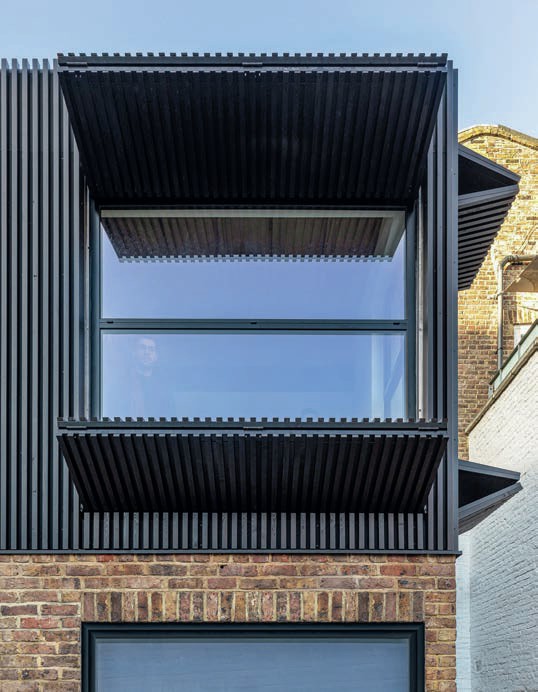
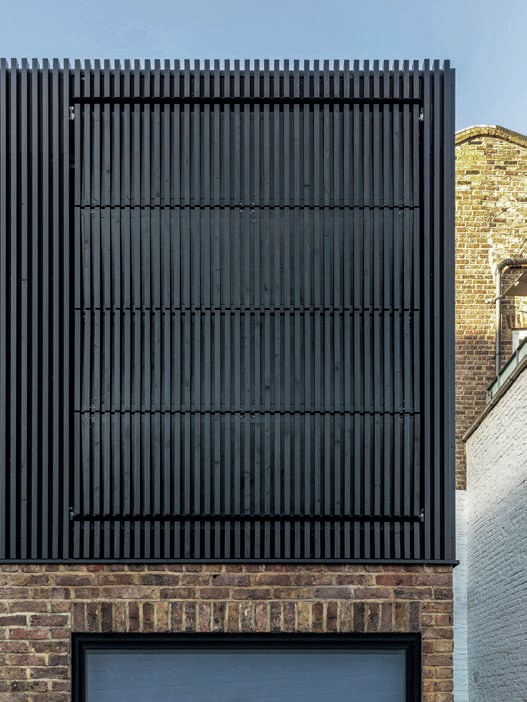
In this London project by MATA Architects (www. mata-architects.
co.uk), bespoke Siberian Larch timber shutters counter summer solar gain, whether shut tight or fully opened to form an overhang. They are operated manually from the inside using winches
PETER LANDERS
Insulation and airtightness in new build homes have dramatically improved thanks to Building Regulations updates over the decades, in an effort to reduce our energy bills and slow down the effects of global warming. With this, however, comes a new problem. As the UK experiences hotter climates, our buildings are more likely to suffer from unpleasantly high temperatures in summer. Unlike traditional houses, newer buildings have fewer draughts to help keep them cool on hot days, and their extra insulation can trap unwanted heat. This in turn has led some desperate homeowners to invest in air conditioning, which is not only expensive, but also ironically one of the worst generators of greenhouse gases.
So, in June 2022, the government introduced a new section to the Building Regs to counteract overheating, collectively known as Approved Document O. The aim is to limit unwanted solar gains in summer and provide adequate means to removing heat from the indoor environment. Building houses in a way that can control excess solar gains will inevitably change the way in which they are designed. Here’s what you need to know, and the design techniques you can use in your build to respond to Part O.
What is Part O and how is it changing home design?
At the moment, this regulation only applies to new build homes, not extensions, conversions or conservatories. However, Building Regulations are likely to become increasingly restrictive over the next few years and, as such, the exterior design of our houses will evolve.
The primary cause of our homes overheating is the greenhouse effect, where sunlight shines into a room and warms up its contents, raising the temperature inside. A much-loved aspect of contemporary house design is large areas of glazing, particularly double or triple height atriums and long runs of sliding or bifold doors. At first glance, the new Building Regulation seems to be ruling out these designs – especially if they are south facing. However, its influence on house design is in fact more nuanced, so don’t fear – you can still achieve stylish glazed features!
Part O tackles the overheating problem from two directions: by reducing the amount of heat from the sun that gets into the house; and by making it easier to cool down. This is to be achieved by a combination of reducing or shading areas of glass on the elevations, and by requiring a minimum area of openable windows and/or the introduction of mechanical ventilation systems.
Demonstrating compliance
In order to show that your house design meets the requirements set out in Approved Document O, one of two calculation methods can be used. The first of these is reassuringly introduced as the simplified method, but if you read it, it soon becomes clear that this description is misleading – unless you have an enthusiasm for mathematical problems. The calculation starts by identifying the elevation that has the largest area of glazing and then looking at its orientation. Then, depending on whether the house has cross-ventilation or not (meaning if there are openable windows on opposite sides of the building), Approved Document O provides tables which give you the maximum percentage of glass allowed for the floor area of the house and the maximum area of glass allowed for the most glazed room.
The simplified method also requires the area of openable windows to be worked out as a percentage for the whole house, and each room. This is to prove that there is enough free ventilation to remove unwanted heat, but there’s a catch. Any windows that are likely to remain closed due to noise or pollution or to keep the house secure are assumed to be shut some of the time and therefore do not count. So, for some house designs it will be difficult to show that they comply with the regs by using this method.
Where this calculation is used, the modifications needed are likely to be visible on the outside of the house. Window and door openings will have to be smaller than before, reducing the daylight levels inside. Surprisingly, rooflights are not mentioned as being relevant, so they are a useful way of preventing rooms from becoming too gloomy.
The simplified method only allows for a very limited analysis, and so it offers restricted design options. This is particularly a problem where self builders want to have plenty of glazing and offset it with solar control measures, or where mechanical ventilation is to be used. In these cases, the more complex dynamic thermal modelling method can be used. This requires computer software to predict how the building will perform in terms of overheating. It is powerful enough to calculate the likely temperatures in each room for any given day of the year. Dynamic thermal modelling makes more creative solutions possible, such as using a combination of solar shading design features on elevations facing in different directions. It also takes into account window sizes and their positioning, so that altering the floor layout might allow more glazing on elevations in certain orientations. By way of illustration; a pattern book house design might comply in the case of one orientation but fail if it is turned 90° in plan because the sunlight entering each elevation will change. Dynamic modelling gives the chance to understand and address these issues in bespoke design.
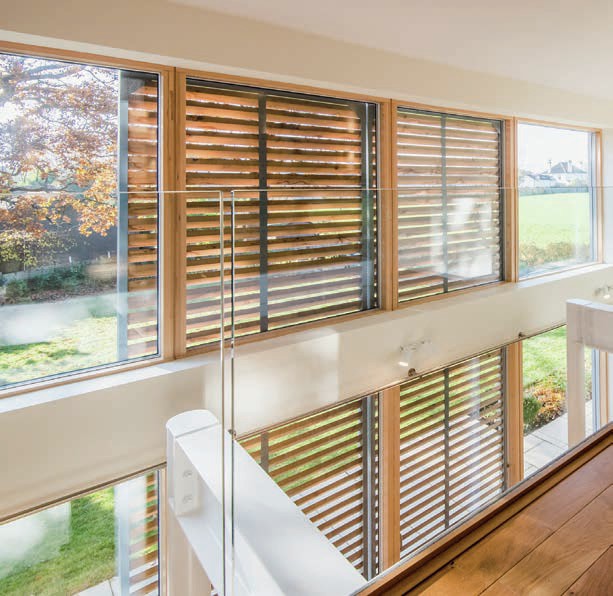
Larch louvre shutters have been installed on the main south-facing windows of this new build home designed by MJW Architects (www. mjwarchitects. com). They limit the amount of sunlight coming into the house to stop overheating, while still allowing in plenty of light. They’re moveable, too, to respond to the time of day and views
CAMILLA REYNOLDS
TOP DESIGN TIPS FOR LIMITING OVERHEATING
ORIENTATION. Consider the direction in which each facade of your build will face during the design process and the effect glazing here will have, particularly those that are orientated to the south. Assuming that it is fairly permanent, the surrounding landscape will also affect how much sun gets through the windows and therefore how warm it will get.
CREATE OVERHANGS. Even increasing the recess around window and door openings will have an impact. Other updates to Building Regs require thicker wall insulation, making it easier to achieve a shaded effect.
BRISE SOLEIL. Large commercial buildings have been using them for a while and a variety of design options are available. Consider awnings for exposed locations vulnerable to high winds, as these can be retracted.
SHUTTERS. Installing inward-opening windows allows for exterior shutters with louvres. These can be locked at night so that the house remains secure while allowing natural ventilation to cool the interiors. Micro louvres can also be fixed to the front of a window frame, using very thin blades arranged in a way that lets in plenty of daylight. Bear in mind that internal blinds reflect a small amount of warmth, but have limited use for preventing your home from overheating.
LOOKALIKE PANELS. If you want to achieve the visual impact of a large wall of glass without excessive temperatures, consider using panels that mimic the look of your fenestration. These sit in the same frame as the glass, blocking out sunlight while still mimicking the look of glazing.
SOLAR CONTROL GLAZING. The special tinted coating reflects and absorbs heat, but be aware some types also reduce the amount of daylight.
WINDOW OPENINGS. Ensure windows can be opened to 90° to allow a breeze to travel through the house. Restrictors can be fitted to limit how far they open if you have children or pets, or want further security, which can be disabled by pressing a catch on the mechanism.
ROOFLIGHTS. Heat rises, so openable roof windows are great for ventilating a warm space, as well as upping daylight levels.
Moderate and high risk locations
The greatest visual impact of Part O is expected to be in London. It has been deemed a high-risk area for buildings to overheat, given that large cities tend to absorb and store more heat than smaller conurbations. In addition to following the maximum glazing areas set out in Approved Document O, residential buildings in the capital require shading on glazing that faces northwest and northeast via the south. It is logical to expect these rules to eventually be applied to other large cities such as Manchester, where this guidance is currenty recommended but not yet enforced.
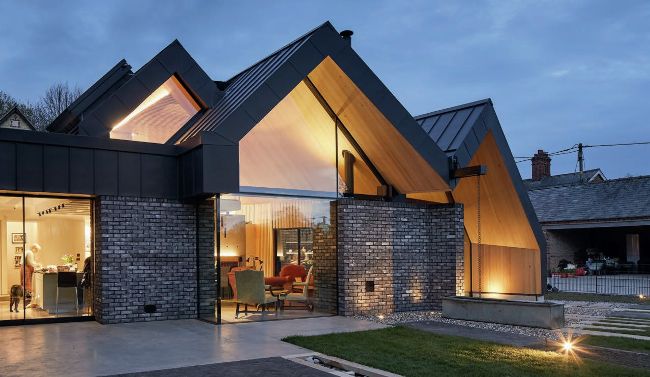
The extended roofline of this build by CDC Studio (www.cdcstudio.
co.uk) provides solar shading to the westfacing glazing
HUFTON+CROW
In these high-risk locations, shading for glazing that faces due south can be achieved by creating projections above the openings with a 50° altitude cut-off, which results in a projection of at least a metre for an ordinarysized window. This shading can be provided by part of the building above overhanging (such as the roof), or by adding structures that extend horizontally out from the wall. A popular version of this is the brise-soleil, which is made up of a frame containing timber or metal fins that are angled to shade the high sun but allow light and air to flow through. This means that they are less vulnerable to damage from the wind and are great for bright and airy spaces, as they don’t block out as much daylight as a solid version would. A variation on this theme is to fix a louvre vertically outside the window. The more sophisticated types are motorised and controlled either by a handset or a building management system that tracks the sun and closes them for extra security. It could be that side-hinged external shutters which are often seen on the continent become more common in the UK, as they provide a simple way to allow windows to be left open while preventing intruders. However, the outward opening windows we use in the UK would instead need to open into the room if these shutters are to be installed, so they may be trickier to retrofit.
JULIAN OWEN
Julian Owen is an East Midlands-based chartered architect and author of several books on self build and house alterations. His publications include Self Build, Home Extension Design and Kit and Modern Timber Frame Homes. He’s also the founder of the ASBA Architects network. To find out more visit www.asba-architects.org.
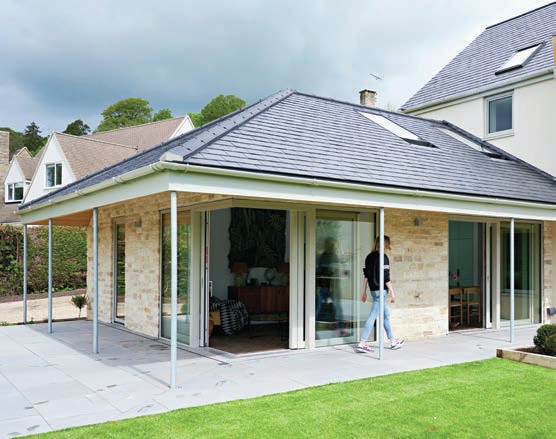
In this new build home by Rixon Architects (www.rixon
architects.com), the single-storey volume’s timber veranda is designed to keep the sun out of the living spaces so they can stay cool at the height of summer
ADAM CARTER
A less obtrusive measure to reduce solar gain that is allowed by the regulations for London is the use of tinted glass, which limits the number of infrared rays that can pass through – the main culprits for heat build-up. However, the tint that’s required is likely to negatively affect the appearance of the elevations during the day.
In many cases, the requirements of Approved Document O will not only affect the internal layout of your build but also directly influence the appearance of your home’s facade, with details such as overhangs becoming a dominant feature. Therefore, there is a good case for getting the provisional calculations recommended in the regs carried out prior to putting in a planning application.