Getting airtightness right in new homes
Sustainability expert Nigel Griffiths looks at how you can address uncontrolled air leakage to boost your self build project’s performance
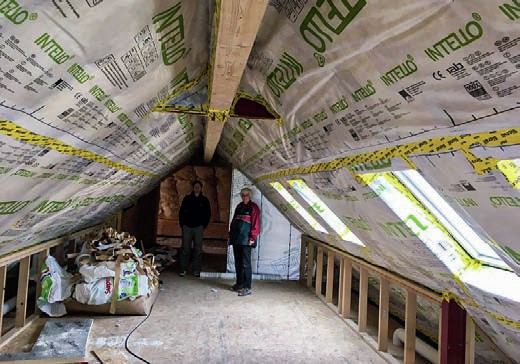
Winner of the 2021 Build It Award for Best Timber Frame Home, Gryphon House achieves Passivhaus standards for airtightness. The project combines Frame Technologies’ efficient TechVantage S timber frame system with a ProClima Intello airtight vapour control membrane and Siga Sicrall sealing tape
When air leaks out of a building, heat will escape along with it. So, it’s no surprise that good airtightness is a key strategy for reducing energy demand from space heating in new homes. Hence why airtightness has had so much attention from exponents of Passivhaus and other low energy construction approaches, as well as in the UK Building Regulations. To many self builders, however, controlling air leakage can feel like a bit of a dark art. Here are the essentials you need to know to get the right result on your project.
Why airtightness is important
As we’ve become better at insulating our homes, the amount of heat lost through the building fabric has fallen sharply. That’s true even for properties constructed just to the minimum standards of Building Regulations. What this means, in turn, is that the proportion of heat lost through uncontrolled air leakage has become relatively higher.
Unfortunately, many modern houses do not perform as well as they are designed to do. This issue is known as the performance gap, and poor airtightness is one of the major causes of this issue. So, achieving a really airtight building requires great attention to detail during both the design and construction stages, including careful specification and sequencing to make sure that airtightness membranes are installed correctly.
Crucially, this can’t be done in isolation. Nobody wants to live in a stifling, sealed up box – so the provision of fresh air (ie ventilation) must go hand-in-hand with your project’s airtightness strategy. The importance of this has been underpinned via recent changes to Part F of the Building Regs (see the box out, overleaf, for more info).