THE WILD SIDE
Photographing the animal kingdom … without becoming part of the food chain
STORY AND PHOTOS BY CHRIS COLLARD
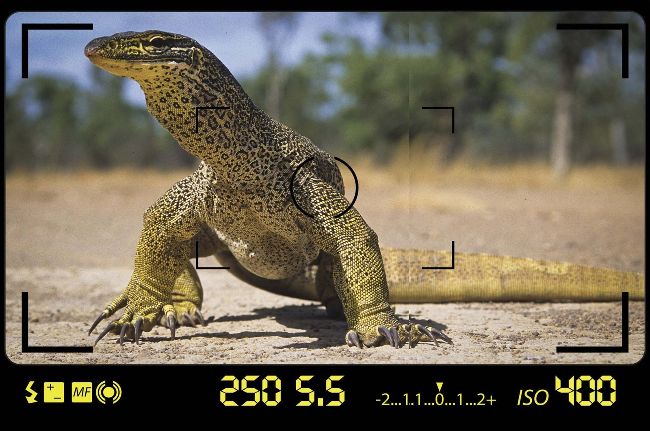
Getting down on your belly can put you eye to eye with terrestrial critters such as this large, yellow-spotted goanna we met on a dirt track in northern Australia. (Canon EOS 3, 70-200mm f/2.8L IS lens, Fujifilm Provia 100F film)
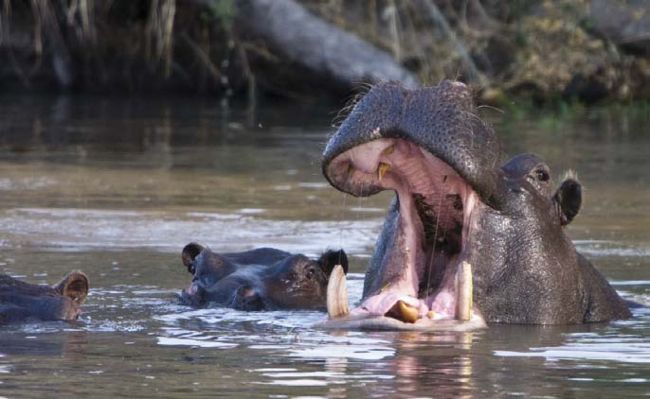
Hippos take refuge from the heat in a Botswanan water hole (Canon 40d, 70-200mm f/2.8L IS lens, 2X extender, f/8.0, 1/320 sec, ISO 400)
Amidday sun beat down on the northern reaches of Australia’s Top End, tapping the desiccated soil for any remaining moisture and sending the mercury toward the century mark. We were somewhere between Cairns and Darwin, skirting the Bay of Carpentaria, during a three-week “Down Under” adventure.
Cresting a rise, I glimpsed what appeared to be a log in the road … but it was moving— a large, yellow-spotted goanna. I hit the brakes, jumped out with camera in hand and slowly approached.
When it headed for the bush, I ran to cut it off at the pass. It went the other way, and I circled around. This scenario repeated until it finally settled down and we sat there staring at each other. Dropping to my belly put me eye to eye with this beautiful specimen of the animal kingdom. Intrigued with the rich color and detail of its scales, the fact that a goanna’s saliva is highly infectious must have slipped my mind. I inched forward, fired a few frames, inched forward, repeat.
In previous “Viewfinders,” we’ve talked about situational awareness, always having a camera nearby and approaching photography as a novelist pens chapters of a book. The wildlife we encounter might be a mere slice of the adventure “pie,” but as visual storytellers, we need to leave our audience salivating for another bite. After all, would a chapter on southern Africa be complete without at least one photo of an elephant?