FLAT OUT RACE BIKES
OLLY TOWNSEND TAKES ON THREE CARBON BIKES FROM BMC, NINER AND TREK WITH ONE THING IN MIND. ABSOLUTE, NO COMPROMISE RACE SPEED.
WORDS BY OLLY TOWNSEND
PICTURES BY OLLY TOWNSEND
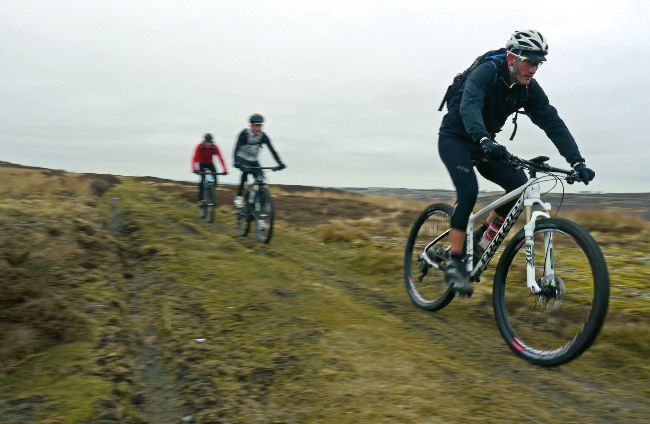
A cross-country mountain bike race will normally involve the following – a course marked out with race tape, a commentator with a crackly PA system, a catering van, a muddy car park, a couple of uber-keen people warming up on turbo trainers and, most importantly, lots of lightweight, minimally suspended cross-country race bikes.
The thing is though, the majority of mountain bikers don’t go to a race course to race. You can race equally as well with a few of your mates and a stretch of your favourite trail. The phenomenal success of Strava shows that racing still exists, but now it’s often between you and your friends, or you and an unknown rival in a digital parallel universe somewhere.
So if you’re going to beat your friends, or get the KOM on a particular stretch of singletrack, you’re going to need the right bike. And in the somewhat fragmented world of mountain biking, where bikes are steadily becoming more specialist, that means you’ll need a cross-country race bike.
For the majority of dedicated cross-country racers, a typical race bike would be carbon-fibre framed, have 29in wheels, most likely be a hardtail and have somewhere around 100mm of front suspension. They will generally have quite steep angles (70–71° head angle and 72–73° seat angles are pretty common) to make them responsive and quick steering. And there won’t be a dropper post in sight!
Cross-country race bikes can look old fashioned, with their arsein-the-air-head-down layout. But if you own one (and particularly if you do actually race it), then the chances are that you will also wear brightly coloured Lycra and you may well shave your legs and in that case, the fact that your bike looks different to the on-trend big travel bikes you’re more likely to come across at your local trail centre is not going to bother you that much.
In recent years, manufacturers have produced ever lighter and stiffer hardtail cross-country race bikes – frame weights of some of the top-end models are now often within a few grams of a typical road or cyclocross frame. But with this extra stiffness often comes harshness. In the world of prolevel racing where racers are paid to be clothes horses for their sponsors, they will put up with the discomfort of their steeds because race results are everything – they know where their pay comes from after all. But for mere mortals, sacrificing a few extra grams for a bit more comfort might well be a trade-off worth taking, so this issue we’ve looked at three cross-country race bikes where the manufacturers have tried to add a little comfort to the pain of thrashing around a race course.
We’ve got three slightly different takes on the conundrum of balancing speed versus comfort – firstly a ‘softail’ from BMC with its Team Elite TE01 which uses an elastomer stack sandwiched into the seatstays to offer 15mm of vertical movement, then a traditional hardtail (albeit one with bigger tyres and more suspension) from Niner in the form of a Air 9 Carbon, and finally a wolf in sheep’s clothing from Trek with a Procaliber 9.8 SL which utilises the IsoSpeed decoupler taken from its Madone and Boone road/cyclocross bikes to offer 11mm of compliance at the saddle.
Lisez l'article complet et bien d'autres dans ce numéro de
Singletrack
Options d'achat ci-dessous
Si le problème vous appartient,
Connexion
pour lire l'article complet maintenant.
Numéro unique numérique
105
Ce numéro et d'autres anciens numéros ne sont pas inclus dans une nouvelle version de l'article
abonnement. Les abonnements comprennent le dernier numéro régulier et les nouveaux numéros publiés pendant votre abonnement.
Singletrack
Abonnement numérique de 6 mois
€12,99
facturé deux fois par an
Abonnement numérique annuel
€23,99
facturé annuellement