FILE UNDER...
Tango master’s breakout
Towards the end of his life, tango giant Astor Piazzolla gave it everything he had.
By Jim Irvin.
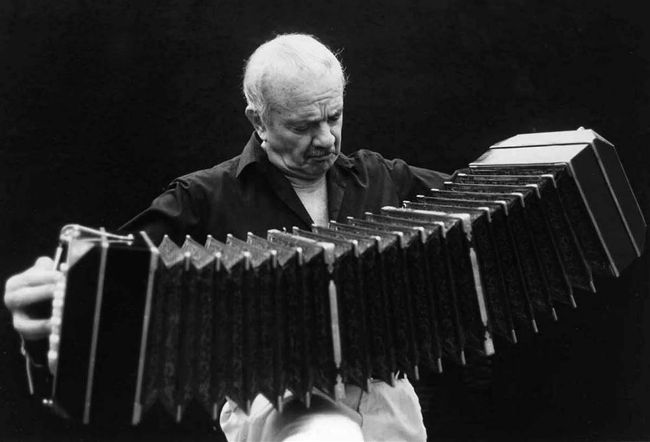
Putting the squeeze on: Astor Piazzolla was a unique, complex artist.
ASTOR PIAZZOLLA was a prodigy on the bandoneon, or button accordion Born in Argentina in 1921 of Italian immigrant parents, he grew up in Greenwich Village and Little Italy, New York, took up the instrument aged eight and composed his first tango aged 11. At 14, he was spotted by tango legend Carlos Gardel, who invited him to tour with his orchestra. Piazzolla was crushed when his father refused permission. Shortly afterwards, the whole Gardel touring party perished in a plane crash. Astor would later joke that, had his father let him go, he’d be playing the harp.
At 17, Piazzolla moved to Buenos Aires and studied under Argentinian classical composer Alberto Ginastera, who taught him orchestration. His Octeto Buenos Aires, formed in 1955, was effectively a chamber orchestra with added bandoneons, but it improvised like a jazz ensemble. This blend of tango, jazz and classical music was dubbed ‘nuevo tango’ and proved controversial to the point of Piazzolla receiving death threats for daring to tamper with the form. Undaunted, he would experiment with tango for the rest of his life.
Now Nonesuch Records release a 3-LP/3-CD box set, Astor Piazzolla: The American Clavé Recordings ★★★★, gathering a trio of albums originally issued in the 1980s: Tango: Zero Hour, La Camorra, and The Rough Dancer And The Cyclical Night (Tango Apasionado), the first time they have been available on vinyl since their initial release on American Clavé, the label founded by producer Kip Hanrahan, who writes in the sleevenotes: “I’m not sure whether Astor really loved or hated the tango. I think he loved the music his father surrounded the family with, the sound of what they’d left behind in Argentina… It was the audible identity that made them different from the Italian and Jewish families on the Lower East Side of New York. When I listen to Astor, I’m listening to the music of a turbulent, complex, restless, brilliant man rearranging the vocabulary of his father’s dreams.”
That impulse to keep challenging stylistic assumptions, constantly tweaking the levels of traditionalism in the form, makes his work rewarding. It ranges from torch songs on rain-lashed streets (check the glorious Five Tango Sensations, commissioned by the Kronos Quartet and released in 1991), to lusty carnivals where cultures clash and passions flare. His music can be cerebral, carnal, playful or intense by turns. Consequently, these albums have markedly different textures. Tango: Zero Hour was recorded with his New Tango Quintet; bandoneon plus guitar, violin, piano and bass. At the time, 1986, Piazzolla declared it “the greatest record I’ve made in my entire life. We gave our souls to [it].” 1989’s La Camorra, the most classical of the three, was Piazzolla’s last recording with the Quintet. Hanrahan recalls multiple occasions when he’d be fired by this truculent perfectionist, after a flaming row about some aspect of the work, only to have him call early next morning: “Kip, I was thinking…”