QUESTION OF THE MONTH
Q&A
YOUR QUESTIONS ANSWERED
... WHAT IS AN AMBIVERT?
... DOES EATING SPICY FOOD GIVE ME ACID REFLUX?
... WHAT IS PHANTOM VIBRATION SYNDROME?
... WHAT IS A SQUALL LINE?
... DOES MASSAGE WORK?
... HOW DOES A QUEEN BEE GET TO BE QUEEN?
... WHAT IS VERTICAL FARMING?
... WHAT IS SLEEP INERTIA?
... WHY DO DOGS LOOK LIKE THEIR OWNERS?
... WHY ARE BISCUITS SO ADDICTIVE?
... HOW DOES FOG FORM?
Email your questions to questions@sciencefocus.com or submit on Twitter @sciencefocus
OUR EXPERTS
DR CLAIRE ASHER Science journalist
DR HELEN SCALES Marine biologist and author
LUIS VILLAZON Science and technology writer
PETE LAWRENCE Astronomy expert
DR CHRISTIAN JARRETT Psychologist and author
CERI PERKINS Science writer
PROF ALICE GREGORY Sleep expert
DR EMMA DAVIES Science writer
DR HELEN PILCHER Biologist and science writer
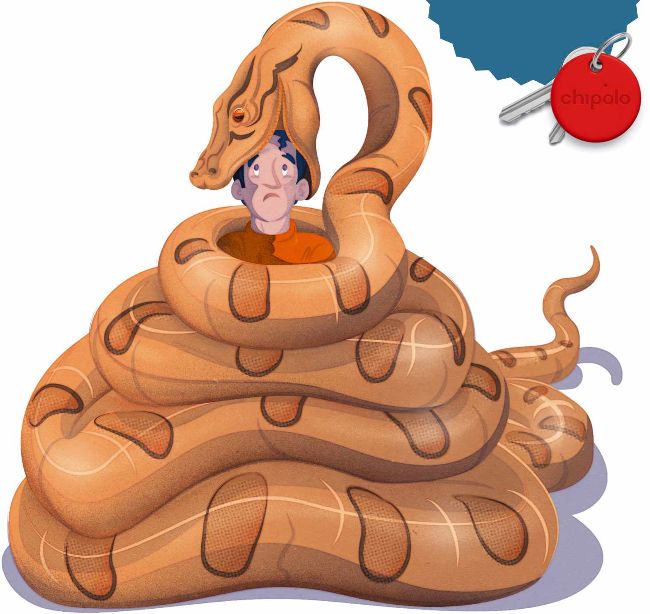
ILLUSTRATION: DANIEL BRIGHT
CHRIS HAMER, LONDON
IF YOU WERE SWALLOWED WHOLE BY A VERY LARGE ANIMAL, HOW LONG WOULD YOU REMAIN ALIVE FOR AND WHAT WOULD YOU DIE OF?
WINNER
The winner of next issue’s Question Of The Month wins a Chipolo tracker bundle, worth £70. The prize includes a Chipolo card to slip inside your wallet, and two Chipolo keyrings. Connect the Chipolo trackers with the companion app, which will let you find your belongings if they get misplaced.
Never lose your keys again! chipolo.net
In 2014, Discovery Channel aired a controversial documentary where the presenter attempted to get eaten alive by a six-metre anaconda, while wearing a protective suit. The snake attacked, but the stunt was halted before the man was swallowed, since he was in danger of having his arm broken by the anaconda’s constricting coils. Anacondas will always suffocate their prey to death first before swallowing it, since it would be dangerous to have a live deer or tapir kicking in the stomach. Even when their prey is dead, swallowing something this large is quite risky for these snakes and they can sometimes die in the attempt. Other large animals such as crocodiles would certainly bite you into smaller chunks first. A large whale could theoretically manage it, although blue whales have a surprisingly narrow oesophagus and can’t swallow anything larger than a melon. In reality, the only animal large enough to swallow you whole without killing you first, or in the process, is a sperm whale. But even if you manage to dodge its teeth, your death certificate would still say ‘chomped to death’. Sperm whales use their teeth to catch and hold large prey, but they don’t chew with their mouths. This job is delegated to the first of their four stomach chambers. The stomach walls are very thick and muscular, to grind up fish and giant squid, before they pass to the other chambers and digest in the gastric juices.
There is no breathable air in a whale’s stomach, so you would have at most three minutes before you asphyxiated. But before that you would have been crushed to death, in a scene reminiscent of the trash compactor sequence of Star Wars: Episode IV.
LV
ASTRONOMY FOR BEGINNERS
NOCTILUCENT CLOUDS (NLCs)
WHEN: LATE MAY-EARLY AUGUST
Night darkness is in short supply during the middle of the year, as sunset is late in the day and sunrise early. In addition, the Sun’s position below the northern horizon in the middle of the night means much of the UK never sees proper darkness at all. Although this is a challenging time for stargazing, there is another phenomenon that can only be seen at this time of year.
Noctilucent clouds (NLCs) are ice-sheet clouds forming at an altitude of around 80km (50 miles) in a thin region within the mesosphere. The mesosphere is a defined layer of Earth’s atmosphere, extending from an altitude of 50-120km (30-75 miles).
During the northern hemisphere’s summer, the temperature of the mesosphere drops and any water vapour present becomes supercooled.
If small particles pass through the supercooled vapour, tiny ice crystals form, creating NLCs. If you’re wondering what the astronomical connection is here, the natural supply of seeding particles is the dust left after a meteor vaporises in the atmosphere.
If present, NLCs can normally be seen low above the northwest horizon between 90 and 120 minutes after sunset, or low above the northeast horizon before dawn. Extensive displays may appear low in the northwest, track through north and end low in the northeast.
Despite the Sun having set for us on the ground, from the altitude of the NLC sheet the Sun is still up.
Consequently, the sheet reflects sunlight and, from our perspective at least, appears to shine at night. This is where they get their name: noctilucent means ‘night shining’.
NLCs can be very beautiful, glowing against the deep twilight sky with a vibrant electric blue colour and often showing fine, net-like structures.
PL